
Preservation in Print – Playhouses and Privilege: The Architecture of Elite Childhood
Please note, this program will NOT be recorded.
Join the California Preservation Foundation for Preservation in Print, a free lunchtime series for anyone interested in historic preservation, architecture, planning, history, and related fields. Each one-hour session features a conversation with the author or a key contributor of a recent preservation-related title. There’s no need to read the book in advance—whether you’ve read every page, browsed the photos, or are simply curious, you’re invited to join. The program includes a brief presentation by the guest speaker, followed by a Q&A with questions from CPF’s Education Committee lead and audience members.
Playhouses and Privilege: The Architecture of Elite Childhood
by Abigail A. Van Slyck
University of Minnesota Press, 2025. Description courtesy publisher website.
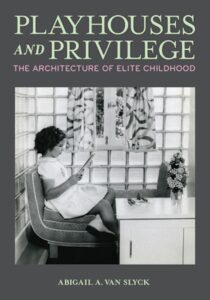 Examining playhouses of the super-rich to understand how architecture contributed to the construction of elite identity and modern childhood
Playhouses and Privilege explores children’s playhouses built on British and American estates between the 1850s and the mid-1930s. Different from the prefabricated buildings that later populated suburban backyards, these playhouses were often fully functional cottages designed by well-known architects for British royalty, American industrialists, and Hollywood stars. As Abigail A. Van Slyck shows, these buildings were more than extravagant spaces to cultivate children’s imaginations and fantasy lives.
Reviewing a rich archive that includes extant buildings, site plans, family photographs, baby books, and intimate household correspondence, Van Slyck demonstrates that these structures were tools of social reproduction shaped by elite parents’ attitudes toward child-rearing, education, and class privilege. Recognizing playhouses as stages for the purposeful performance of upper-class identity, she illuminates their importance in influencing children to internalize gendered codes of conduct as they enacted rituals of hospitality and learned how to supervise servants.
From Queen Victoria and Prince Albert’s Swiss Cottage, built on their Osborne estate in 1853, to the children’s cottage constructed on the grounds of Cornelius Vanderbilt’s Newport mansion in 1886, and from the miniature bungalow commissioned in 1926 for the Dodge Brothers Motor Company heiress to the corporate-sponsored glass-block playhouse given to Shirley Temple in 1936, Van Slyck surveys a variety of playhouses and their milieus to trace the evolution of elite childhood and the broader social practices of wealth. Playhouses and Privilege makes clear that, far from being frivolous, playhouses were carefully planned architectural manifestations of adult concerns, integral to the reproduction of class privilege.
Be sure to pick up a copy! Find it at your local bookstore, direct from the publisher or other online retailers.
About the Author
Abby Van Slyck is an internationally recognized architectural historian whose research examines building typologies, gender, and the spaces of childhood. She is the author of Free to All: Carnegie Libraries and American Culture, 1890–1920, among other titles. A two-time Fulbright scholar, she has also served in leadership roles as President of both SAH and the Vernacular Architecture Forum. Van Slyck is Dayton Professor Emerita of Art History and Architectural Studies at Connecticut College, where she also served as Dean of the Faculty.