Novel Material Substitution of Heritage Components
Get CPF updates
Sign up below to receive advocacy alerts and updates from CPF.
Written by Ean Frank, Project Manager, EverGreene Architectural Arts, Inc. for the online educational workshop, “Preservation Tech – The Three Gs: GFRC, GFRC, and GFRP”
 Reverence for traditional materials, the craftsmen who shaped them, and the cultural context from which they emerged is integral to Historic Preservation. Replacing building components with “in-kind” materials is a fundamental tenet of preservation. However, there are instances when such in-kind replacement is not feasible, and strict adherence to this convention may jeopardize a project. In these cases, using novel technologies and techniques may be the only viable solution. As building technology evolves, so does our understanding of what constitutes a novel material. The history of material substitution is nearly as old as building itself, with many once-controversial innovations now considered conventional.
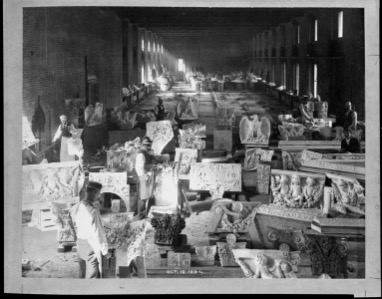
Image: Sculpted marble stored in northeast curtain for construction of the Library of Congress Thomas Jefferson Building, Washington, D.C., Source: Library of Congress
A review of building history reveals numerous materials and techniques initially introduced as novel substitutions that are now widely accepted. Challenges such as material availability, scarcity of skilled labor, and economic constraints faced by past generations are similar to those we encounter today. Innovations such as cast stone, terra cotta curtain walls, and cast-iron façade ornament, once controversial, are now highly valued. Faux treatments like scored stucco, scagliola, terrazzo, and rustication were met with skepticism at their inception but became accepted over time.
The Industrial Revolution brought a surge in mass-produced building materials and streamlined construction techniques, emphasizing efficiency while maintaining the appearance of traditional craftsmanship. Scored stucco to emulate masonry gained popularity, terracotta replaced ornamental stone in nineteenth-century midrise structures, and cast-iron façade ornamentation began replacing expensive carved stone.
Post-World War II in the United States saw a rapid adoption of novel standardized replacement materials. Sheet goods such as plywood and drywall replaced traditional wood cladding and three-coat plaster. Asphalt shingles became more popular than clay tile, slate, wood shingles, and metal roofing. Vinyl and aluminum siding began to dominate residential facades, and composite materials replaced wood and steel windows. Clay and ceramic tiles were often substituted with lower-cost sheet goods or liquid polymer coatings.
The “Three Gs” are a subset of substitute materials, including a fiber-reinforced matrix. These materials are typically lighter and more economical than their traditional counterparts, with their thickness reduced due to their structural density. The components of each composite can be tailored to meet specific application criteria.
Overview of the Three Gs
- Glass Fiber Reinforced Gypsum (GFRG)
-
- What is it: Glass Fiber Reinforced Gypsum (GFRG) consists of high-strength glass strands bonded with gypsum cement. Alpha-gypsum, a stronger binder than the beta-gypsum used in traditional plaster, is employed. Glass fibers can be arranged randomly or directionally based on application needs. GFRG can be seen as a technologically advanced version of traditional plaster casting, offering a more authentic representation of the original material it replaces.
- How is it used: GFRG’s properties make it suitable for both structural and ornamental applications. It is used in pre-engineered buildings in low-income communities and for access panels. Known for replicating complex interior shapes, GFRG is lighter and stronger than traditional plaster while maintaining visual similarity. It is highly fire-resistant, dimensionally stable, environmentally friendly, and relatively easy to install, with potential for additional beneficial properties through specialty additives.
- Glass Fiber Reinforced Concrete (GFRC)
-
- What is it: Glass Fiber Reinforced Concrete (GFRC) combines Portland cement, alkali-resistant glass fibers, sand or fine aggregate, acrylic polymer, and other additives. GFRC is typically four times stronger than unreinforced concrete, with performance further enhanced by fiber orientation and additives like carbon fiber. Although lighter than traditional concrete, GFRC is heavier than other fiber-reinforced alternatives.
- How is it used: GFRC is highly versatile, used in structural elements like modular buildings, tunnels, bridges, and 3D printed structures. It is also employed in landscaping features and contemporary architectural components. In historic preservation, GFRC is used to create resilient backings for ancient mosaics, provide seismic resilience for cathedral domes, replace masonry and terra cotta units, and serve as an affordable alternative to cast iron façades.
- Glass Fiber Reinforced Polymer (GFRP)
-
- What is it: Glass Fiber Reinforced Polymer (GFRP) is a composite material made of a polymer matrix reinforced with glass fibers. The polymer binder can be epoxy, vinyl ester, or polyester resin. GFRP is highly corrosion-resistant, non-conductive, and has a low thermal conductivity. Its strength-to-weight ratio is comparable to steel, and it is a more sustainable option due to its low embodied energy.
- How is it used: GFRP’s unique properties have led to its use across various industries, including automotive, marine, and aerospace, due to its lightweight and corrosion-resistant advantages. It is also used in modern architectural features and historic preservation to replace complex architectural elements affordably. GFRP is employed to reduce structural load and enhance seismic performance, and it has been used to improve blast resistance in masonry structures following the 2001 terrorist attacks.
Guidelines for Determining the Appropriateness of Substitute Materials
Retention, repair, and stabilization of existing historic materials are preferred over replacement. A building’s historic integrity and cultural relevance are closely linked to its physical history, so great care must be taken before opting for replacement. If a historic component is irreparably compromised, in-kind replacement should be the first choice. As summarized in NPS Preservation Brief 16, “All preservation options should be explored thoroughly before substitute materials are used.” The definition of “in-kind” replacement is often ambiguous and left to the designer’s discretion, but similar materials are preferred because they better maintain the historic integrity of the structure, have proven performance in the specific environment, age like the original elements, and reflect the qualities of the original material.
In some cases, in-kind replacement may present significant challenges or risks to completing a project. Preservation practitioners must balance integrity with feasibility, and novel materials may be necessary in such situations. Considerations for using substitute materials include the unavailability of historic materials, lack of skilled craftsmen or technology, inherent flaws in the original material, changes in building codes, and economic constraints.
About the Author
 Ean joined EverGreene in 2023 as a Project Manager with nearly thirty years of dedicated historic preservation experience, including the last two decades successfully managing historic preservation projects. Prior to functioning as a full-time manager, Ean was a traditional trades craftsperson, who specialized in wood and plaster restoration and mortar reproduction. His involvement in projects spans stabilization, preservation, adaptive reuse, and restoration of both public and private venues, completing dozens of high-profile, grant-funded public historic landmark projects, and receiving professional awards and accommodation for his service. He brings extensive experience working in venues containing sensitive and valuable artifacts and secure military sites. A small sampling of these projects includes: Independence Hall, Mission San Gabriel, Tule Lake Internment Camp, Lucy the Elephant, Cliveden and The Sweeton House.
In addition to his direct management and tradesman involvement, Ean has functioned as a safety compliance instructor and implementation officer. He has trained superintendents for numerous general contracting firms in the fundamentals of project supervision and has developed a curriculum tailored to preservation. Prior to joining EverGreene, Ean was a Project Manager with Spectra Company on the West Coast. He has performed management services for national and local general contractors during historic preservation campaigns. In total, Ean has been involved in the preservation of over 100 registered landmarks. Outside of his vocation, Ean was a founding member of the Human Relations Committee in Collingswood, NJ, which operates to ensure an empathetic environment among diverse populations. Ean is also active in competitive martial arts, such as Jiu-Jitsu and MMA. He received his Bachelor of Arts from Rutgers University in Camden, NJ in Construction Management.