
Online Event
Members & Partners
Non-Members
FREE
FREE
Date:
Nov 18, 2026
Time:
12:00 PM - 1:00 PM


All registration fees help support our 501c3 nonprofit organization. You can call (415) 495-0349 or write us to register or get more information.
Upcoming Events
- Public Participation Matters! A Beginner’s Guide to Local Government Meetings
Oct 29, 2026 - California State Historic Building Code: Practical Tools for Preservation, Safety, & Adaptive Reuse
Nov 05, 2026 - Nov 12, 2026 - Preservation in Print - Inland Empire and San Gabriel Valley Movie Theatres Event
Nov 17, 2026 - Treasure Island: The Origin and Legacy of its Splendid Survivors
Nov 18, 2026 - Mapping California: Explore the Archives of the State Library's Collection
Jan 14, 2027
Continuing Education
We are an approved provider for AIA and AICP. Paid programs are submitted for CEUs with AIA and AICP. We also qualify for Certified Local Government (CLG) training. Appropriate continuing education categories (if any) are listed below.
Featured Image Courtesy Jay Galvin
Register for this Event Treasure Island: The Origin and Legacy of its Splendid Survivors
In 1939-1940, twenty cast stone sculptures and a magnificent work of Gladding McBean terra cotta conveyed the theme of “Pacific Unity” on Treasure Island. The Golden Gate International Exposition, “A Pageant of the Pacific”, celebrated a future in which peoples around the Pacific Basin would live in peace. Of course, that didn’t happen and the island became Naval Station Treasure Island to support America’s war in the Pacific.
Where are the sculptures now? For most of the past four decades, they have been in storage in old buildings on the island, an mostly unseen vestige of the fair’s vision.
In the late 1980s, the US Navy and the Treasure Island Museum undertook a preservation program and developed plans for a permanent sculpture garden. Sadly, the Navy abandoned that plan and shortly thereafter announced that the base would be closed, eventually to become property of the City of San Francisco. Six restored sculptures were put on public display for several years, although eventually they, too, were placed in storage. Current discussions, however, offer hope that a new plan for public display is in the works.
These works of art reflect the origins of the world’s fair and Treasure Island itself, as well as the legacy of a vital community of artists creating a vision of a world at peace.
About Our Speaker
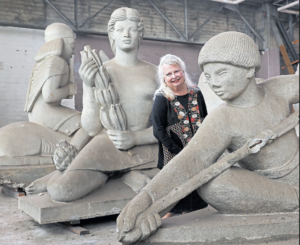
Credit: Mercury News
Anne Schnoebelen is on the board of directors of the Treasure Island Museum. For many years she has been writing and presenting about the history of Treasure Island, the Golden Gate International Exposition and its art programs, and the remaining works of exposition art and artifacts. She also gives walking tours and curates a lecture series for the museum. For more information, please see https://www.treasureislandmuseum.org/media and https://treasureisland1939.com/.